
Better Factory Solutions
14 September 2026
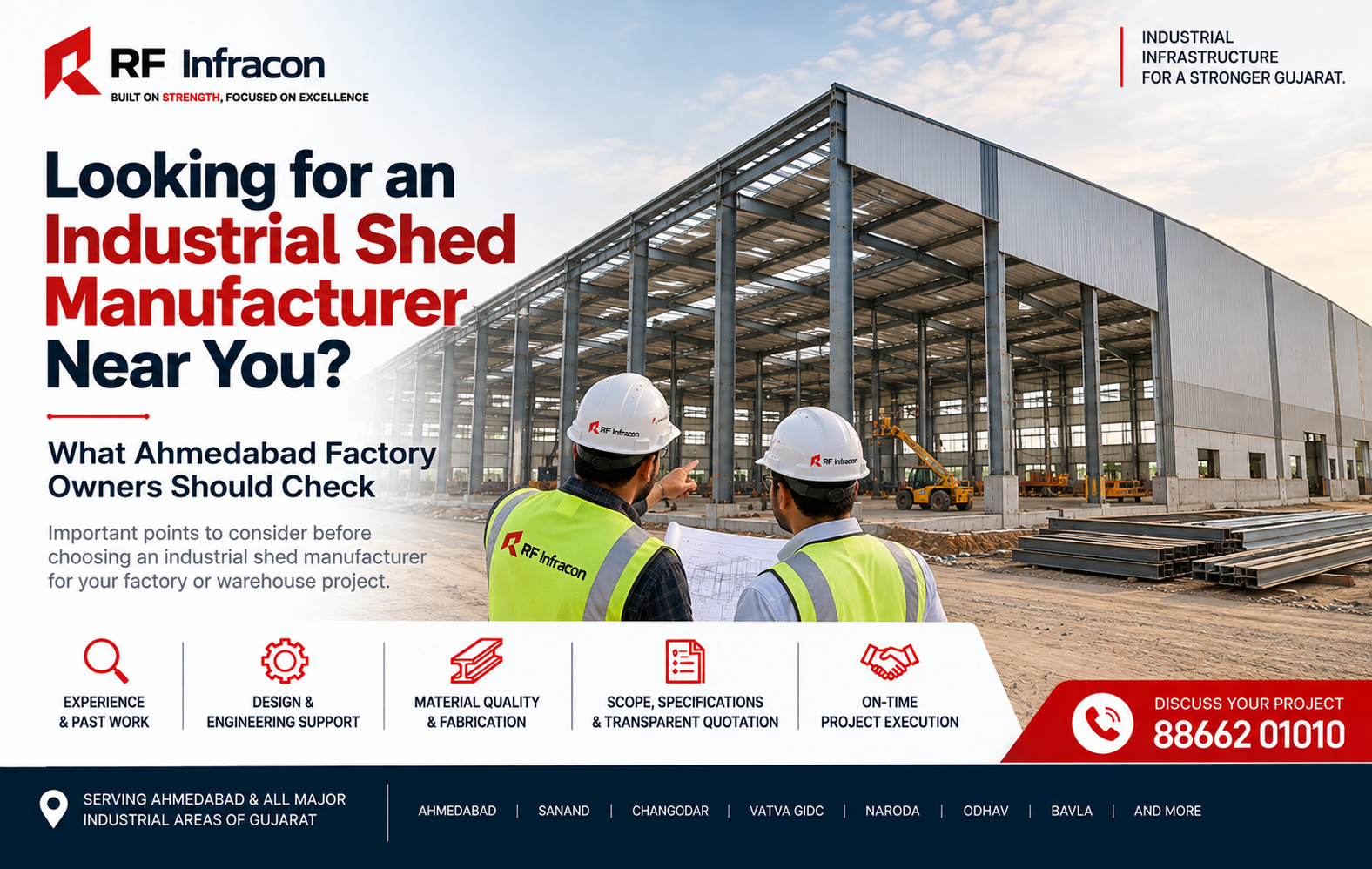

You have the plot, the machinery list is more or less ready, and the only thing standing between you and production is the shed itself. So you do what most factory owners in Ahmedabad do. You open Google, type industrial shed manufacturers near me, and within seconds you are looking at twenty names, everything from a large construction company in Ahmedabad to a one-person fabricator, all promising the same thing.
That is where it gets tricky. On paper, every industrial shed manufacturer looks capable. The website has photos of big clear-span structures, the salesperson quotes a good rate, and everyone says they finish on time. The difference only shows up later, usually after the advance is paid, when the steel that arrives is lighter than promised, or the erection team goes quiet for three weeks during your busiest month.
A factory shed is not a purchase you repeat often. Get it right, and it serves you for twenty-five years with almost no attention. Get it wrong, and you are dealing with roof leaks every monsoon, a structure that cannot take the crane you buy next year, and repair bills that quietly cross whatever you thought you saved. So before you shortlist any factory shed manufacturer, here is what actually deserves a closer look.
There is a reason a search like an industrial shed near me matters more for a shed than for most things you buy. A shed is built on your ground, to your loads, inside your industrial estate, under Gujarat’s specific wind and monsoon conditions. None of that travels well over a phone call from another state.
A manufacturer who is genuinely near you can visit the plot before quoting, not after. They know how the ground behaves in Sanand versus Vatva. They have dealt with the same GIDC office, the same approval formats, the same transporters who bring oversized trusses down narrow estate roads. And when a column needs adjusting during erection, someone reaches the site the same day instead of promising to send a team next week.
Distance also decides accountability. A local industrial shed manufacturer has a reputation to protect in the same market you operate in. If something goes wrong two monsoons later, you know where their office is. That single fact changes how carefully a firm builds.
Sort this out first, because the word manufacturer gets used loosely. Plenty of industrial building contractors only bolt up sections someone else designed. Others buy ready-made members and assemble them on site. What you actually want is closer to a turnkey arrangement, where one manufacturer owns the design, the fabrication, the surface treatment, and the erection.
When design and fabrication sit in the same hands, the person who sized the rafter is answerable for how it performs. When they are split across three vendors, every problem becomes someone else’s fault. Ask plainly who does what. If the answer involves too many outside parties, you are the one who will end up coordinating them.
A shed is only as honest as its steel. Assurances like premium quality or heavy structure mean nothing on their own. Ask for the section sizes, the steel grade, and the paint or coating system in writing. Ask whether the design follows the relevant IS codes for your wind zone and loads. A serious pre-engineered building manufacturer gives you these numbers without hesitating, because their whole design rests on them. A firm that keeps dodging the question is usually hiding thinner steel.
Ask for two or three sheds they have built near you, and go and see one if you can. Not a photo. An actual standing structure. A firm with real industrial shed construction experience in Ahmedabad will have work in places like Vatva, Naroda, Odhav, Kathwada, Sanand, Changodar, Bavla, or Aslali, and will happily point you to it.
A two-year-old shed tells you more than any brochure. Look at the roof joints, the gutters, the base of the columns, the paint. That is roughly what your shed will look like after a couple of monsoons.
Owners often size the shed for the current setup and regret it within three years. Tell the manufacturer about the EOT crane you might add, the mezzanine you are considering, the heavier machine arriving next year. A good steel structure manufacturer designs the frame for where your factory is heading, not only where it stands now. Adding load capacity after the shed is up costs far more than allowing for it at the drawing stage.
Ask how much clear internal width the design gives you. Columns in the middle of the floor limit how you place machines and move material. Then ask how the shed grows when you need more area. A well-planned pre-engineered metal building lets you add bays later without disturbing what is already running inside. That one design decision can save you a shutdown down the line.
When you compare quotes, compare what is inside them, not just the final figure. One firm’s rate may leave out the foundation; another may use lighter sections to reach a lower number. Ask for a written, itemized quotation that lists steel weight, section sizes, sheeting, and exactly what is included and excluded.
The lowest quote is the one to examine hardest. In steel shed construction, a price that looks too good almost always means less steel, thinner sheeting, or costs that reappear later as extras. You are not hunting for the cheapest factory shed manufacturer. You want the one whose number you can actually trust.
Ask for a realistic schedule from drawing approval to handover, and ask who erects the structure. Some manufacturers fabricate well but hand erection to whoever is free that week, and that is where quality and timelines slip. A PEB structure manufacturer that keeps its own erection crew controls the outcome. PEB and prefabricated factory sheds are genuinely faster than conventional construction, but only when one team owns the whole process from drawing to final bolt.
Ask what they do when something needs fixing once the shed is up. Is there a warranty on the structure, and for how long? Who do you call if a gutter leaks in July? Firms that intend to stay in the market answer this easily. Firms that plan to take the payment and move in turn are vague. The near-me manufacturer has an edge here too, because coming back to sort out a small thing is not a big trip for them.
Your shed is not finished when the last sheet goes on. You need drawings and documentation for your factory license, your GIDC records, and structural stability. Confirm that the manufacturer provides stamped drawings and the certificates you will be asked for. Chasing these afterwards out of a firm that has already been paid is a familiar headache. Settle it before you sign.
Keep these ready for every manufacturer you meet:
• Who does the design, and does it follow IS codes for our wind zone?
• What steel grade and section sizes are in this quote?
• Can I visit a shed you built in my area?
• Is erection done by your own team or subcontracted?
• What is the realistic date from approval to handover?
• What is included in this price, and what will be charged extra?
• What warranty and after-handover support do I get?
• Will you hand over stamped drawings and stability documents?
The answers, and how comfortably they come, tell you most of what you need to know.
Slow down if you notice any of these:
• A quote handed over without anyone visiting the plot.
• Reluctance to put steel weight or section sizes on paper.
• No local project you are allowed to go and see.
• A price far below everyone else with no clear reason for it.
• Erection passed to an unnamed third party.
• Vague, drifting answers about what happens after handover.
Owners often ask which is better: a pre-engineered building or a conventional steel shed. There is no single answer. It depends on your span, your loads, and your timeline. PEB structures are usually faster to put up, lighter, and easier to expand, which suits most factory sheds and a typical PEB warehouse well. Conventional fabrication still earns its place for certain heavy or irregular loads. A manufacturer worth hiring will tell you honestly which one fits your case, instead of pushing whichever they would rather sell.
Choosing among industrial shed manufacturers near you comes down to a simple test. Does this firm design and build the whole shed itself, can it show you real work near your plot, and will it still pick up the phone after handover? The rate matters, but it is the last thing to settle, not the first.
RF Infra builds engineered PEB and steel factory sheds across Ahmedabad and Gujarat, keeping design, fabrication, and on-site erection under one roof, with real project experience across Vatva, Naroda, Odhav, Sanand, and the surrounding GIDC estates. If you are planning a new shed or expanding one you already run, it is worth a straight conversation about spans, loads, and timelines before you commit to anything.
Discuss Your Factory Shed Requirement
