
Better Factory Solutions
16 November 2026

SHORT ANSWER Pharma manufacturing plant subsidy in Gujarat comes from two main sources in 2026. New MSME plants can use the state scheme under the Viksit Gujarat Industrial Policy 2026, where pharma is a core thrust sector and the building counts towards eligible investment. Existing units upgrading to revised Schedule M can look at the central RPTUAS scheme for HVAC, clean rooms and utilities. Plan the building around both. |
Gujarat makes a large share of India's medicines, and pharma units keep coming up around Changodar, Sanand, Gandhinagar, Vadodara and the Bharuch belt. Two things are driving a lot of 2026 projects: a new state industrial policy with fresh incentives, and the revised Schedule M rules that pushed many older units to rebuild or upgrade.
Most guides on pharma subsidies list schemes and stop there. Most guides on pharma construction ignore subsidies. This one joins them. It explains the pharma manufacturing plant subsidy in Gujarat options that matter in 2026, then walks through factory setup and construction, so your building, licence and subsidy file move together.
Who is writing: we are RF Infra, a PEB and industrial construction company near Ahmedabad. We have built a pharmaceutical structure in Gandhinagar and other industrial plants. We are not subsidy or regulatory consultants. The scheme figures below come from published summaries as of October 2026, so confirm the details with the District Industries Centre, your CA or a subsidy consultant before you plan around them.
Planning a pharma plant in Gujarat? Send us your plot, product type and room layout. We will send a building plan and a subsidy ready, line item quotation for your project report. |
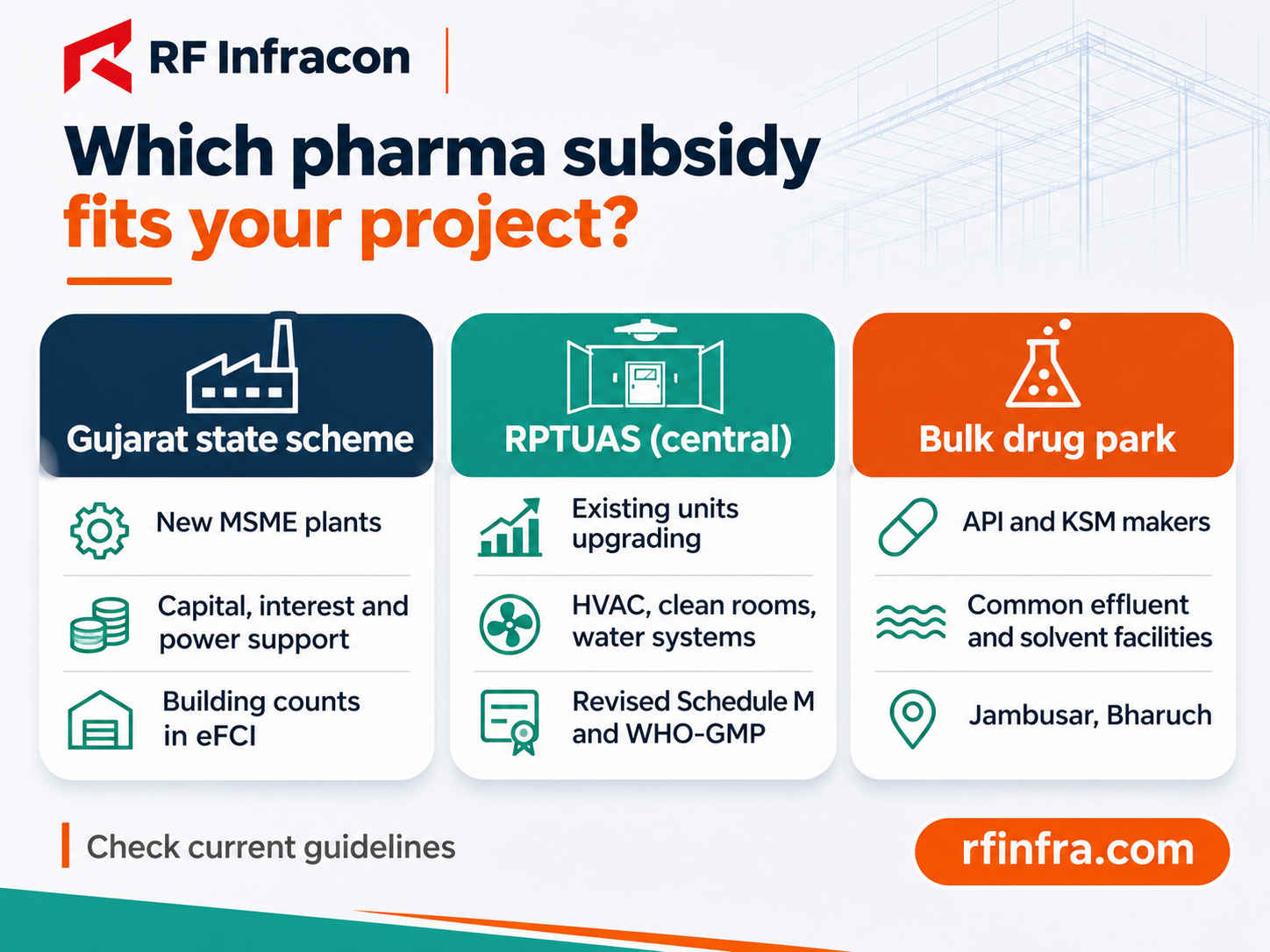
There is no single pharma subsidy. Which one helps you depends on whether you are building new or upgrading, and what you make.
Route | Best for | What it supports |
|---|---|---|
Gujarat state scheme (Viksit Gujarat Industrial Policy 2026) | New MSME pharma plants | Capital subsidy, interest subsidy and power support on eligible fixed capital investment, including building |
RPTUAS (central) | Existing units upgrading to revised Schedule M or WHO-GMP | Reimbursement on upgrades such as HVAC, water and steam systems, clean rooms, labs and effluent treatment |
Bulk drug park, Jambusar (Bharuch) | API, KSM and bulk drug makers | Plots with common effluent treatment, solvent storage and other shared facilities |
You may also find central credit support useful, such as CGTMSE guarantees for collateral free loans. Rules on combining central and state benefits vary, so check before counting on both.
Gujarat state incentives for new pharma plants
The Viksit Gujarat Industrial Policy 2026 is operative from 1 June 2026 to 31 May 2031, and lists healthcare, including pharmaceuticals, bulk drugs, APIs and medical devices, among its core thrust sectors. For MSMEs, consultant summaries of the scheme describe these headline benefits:
Benefit | Category A talukas | Category B talukas |
|---|---|---|
Capital subsidy | 35% of eFCI | 25% of eFCI |
Interest subsidy | 7% for 5 years, up to 10% of eFCI | 7% for 5 years, up to 10% of eFCI |
Power tariff support | Rs 2 per unit for 5 years | Rs 1 per unit for 5 years |
Overall ceiling | 45% of eFCI | 35% of eFCI |
The key point for construction: eligible fixed capital investment is described as covering building, plant and machinery, utilities, tools and equipment. For a pharma plant, that means your PEB building, clean room fit-out, HVAC and utilities can all feed the base on which the subsidy is worked out, as long as they are eligible and properly documented. Land is usually treated separately.
Two cautions. Your taluka's category comes from the official list, so check it before choosing a plot. And units that were already in commercial production before 1 June 2026 generally stay under the earlier 2022 schemes. Larger pharma projects fall under separate large and mega scheme rules.
The Revamped Pharmaceuticals Technology Upgradation Assistance Scheme was announced by the central Department of Pharmaceuticals in March 2024 to help units meet revised Schedule M and WHO-GMP. Published summaries describe it this way:
Open to pharma units with average turnover below Rs 500 crore.
Reimbursement of about 20% of eligible investment for turnover below Rs 50 crore, 15% for Rs 50 to 250 crore, and 10% for Rs 250 to 500 crore.
A per unit cap, reported as Rs 1 crore in some summaries and Rs 2 crore in others, so check the current guidelines.
Eligible items include HVAC, water and steam systems, clean rooms, testing labs, stability chambers and effluent treatment.
Civil and building works are not clearly listed as eligible under RPTUAS in the summaries we have seen. So for an upgrade, the scheme mainly helps with what goes inside the building. If your upgrade also needs a new or extended shell, plan that cost separately, and check whether the state scheme covers it.
For API and bulk drug makers, a bulk drug park is being developed at Jambusar in Bharuch district under the central Bulk Drug Parks scheme, with shared facilities such as effluent treatment, solvent storage and waste management. Infrastructure work, including a Narmada water pipeline, was still in progress in 2026. If you make APIs, compare a park plot with a standalone site, because shared effluent and solvent facilities can change both your building design and your approvals.
API plants also bring corrosion, ventilation and hazardous area design into the building. That is a different kind of project from an oral solid dosage unit, and the structure has to be planned for it.
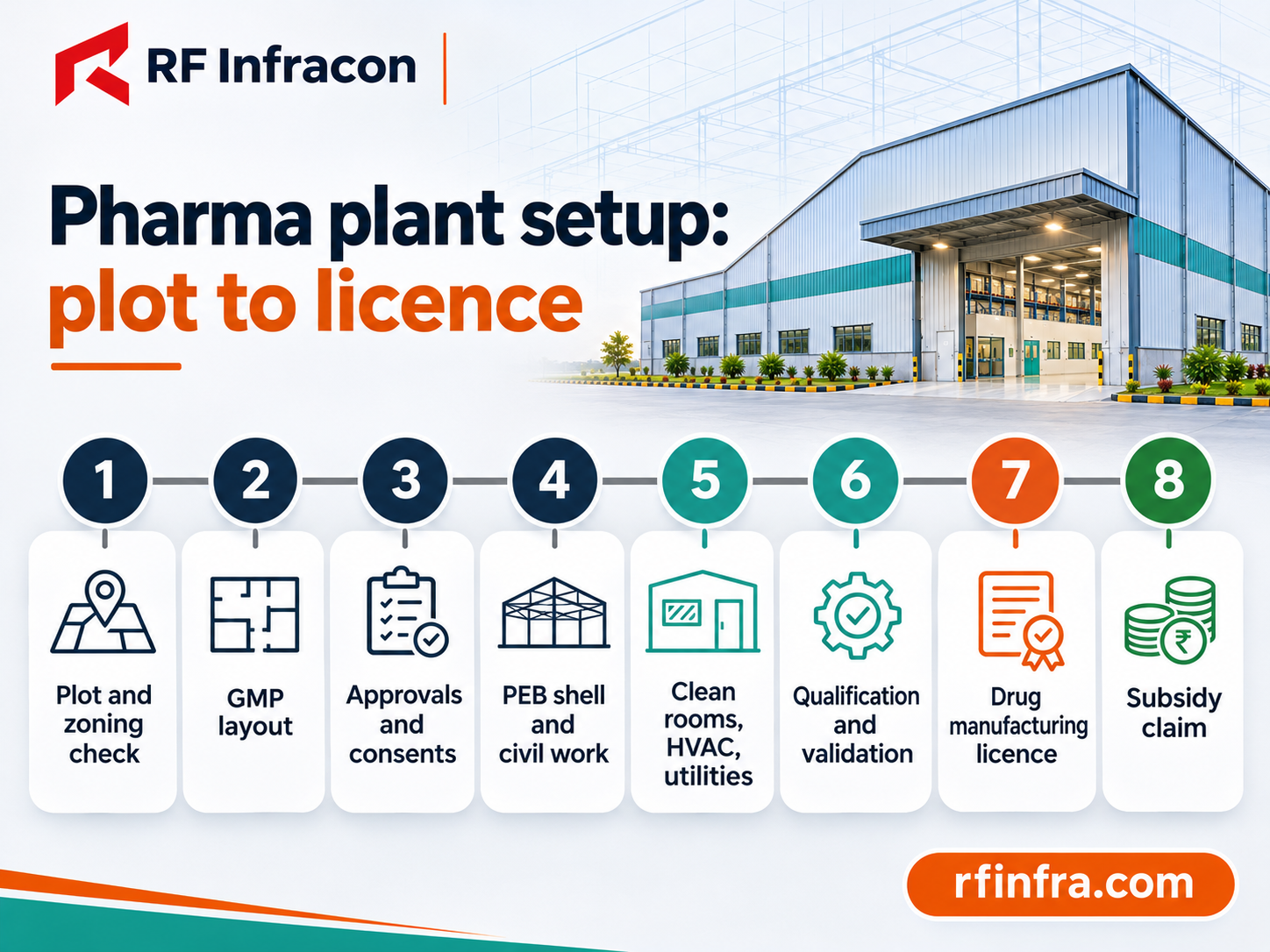
A pharma plant needs the building, the licence and the subsidy file to line up. In practice, the steps look like this:
Choose the plot. Check zoning, taluka category, water, power, drainage and whether the estate allows pharma manufacturing.
Fix the product mix and GMP layout with your consultant: zones, material and personnel flow, clean room grades and utilities.
Get the main approvals and consents, such as building permission, pollution board consent and fire NOC, as they apply to your unit.
Design and build the PEB shell, foundations and floors around that layout.
Install clean rooms, HVAC, water systems and other utilities.
Qualify and validate the facility and equipment.
Apply for and obtain the drug manufacturing licence from the state drug control authority.
Start commercial production and file the subsidy claim within the time limit.
Our checklist before an industrial construction project and guide to factory layout planning before PEB design cover the building side of these steps.
Most new formulation plants in Gujarat use a PEB building as the outer shell, with clean rooms built inside it. The shell has to be designed for what sits inside: walkable ceilings, ducts, AHU platforms, a sealed and insulated envelope, and level floors for panel walls and epoxy finishes. Pre engineered steel buildings suit this well because of wide spans, quick construction and easy expansion. Ask any PEB construction company you shortlist whether it has built a clean process building before.
Share AHU weights, ceiling loads and room heights with the PEB designer before the first drawing.
Set eave height from the clean room height, ceiling void and AHU platform.
Keep the roof over the clean block sealed, insulated and free of skylights.
Plan the stores as a proper warehouse structure with racking height, plus a 2 to 8 degree cold room or cold storage warehouse space if your products need it.
Lay out columns around material and personnel flow, not the other way round.
For heavier or wetter areas, a hybrid can work better, such as a precast building core or RCC for some blocks with PEB for the rest. Our guides on clear span, bay spacing and height planning and PEB vs RCC for industrial buildings help with those choices.
Need your pharma shell designed around the clean rooms? Our engineers coordinate heights, loads and openings with your clean room and HVAC teams, and quote the building line by line. |
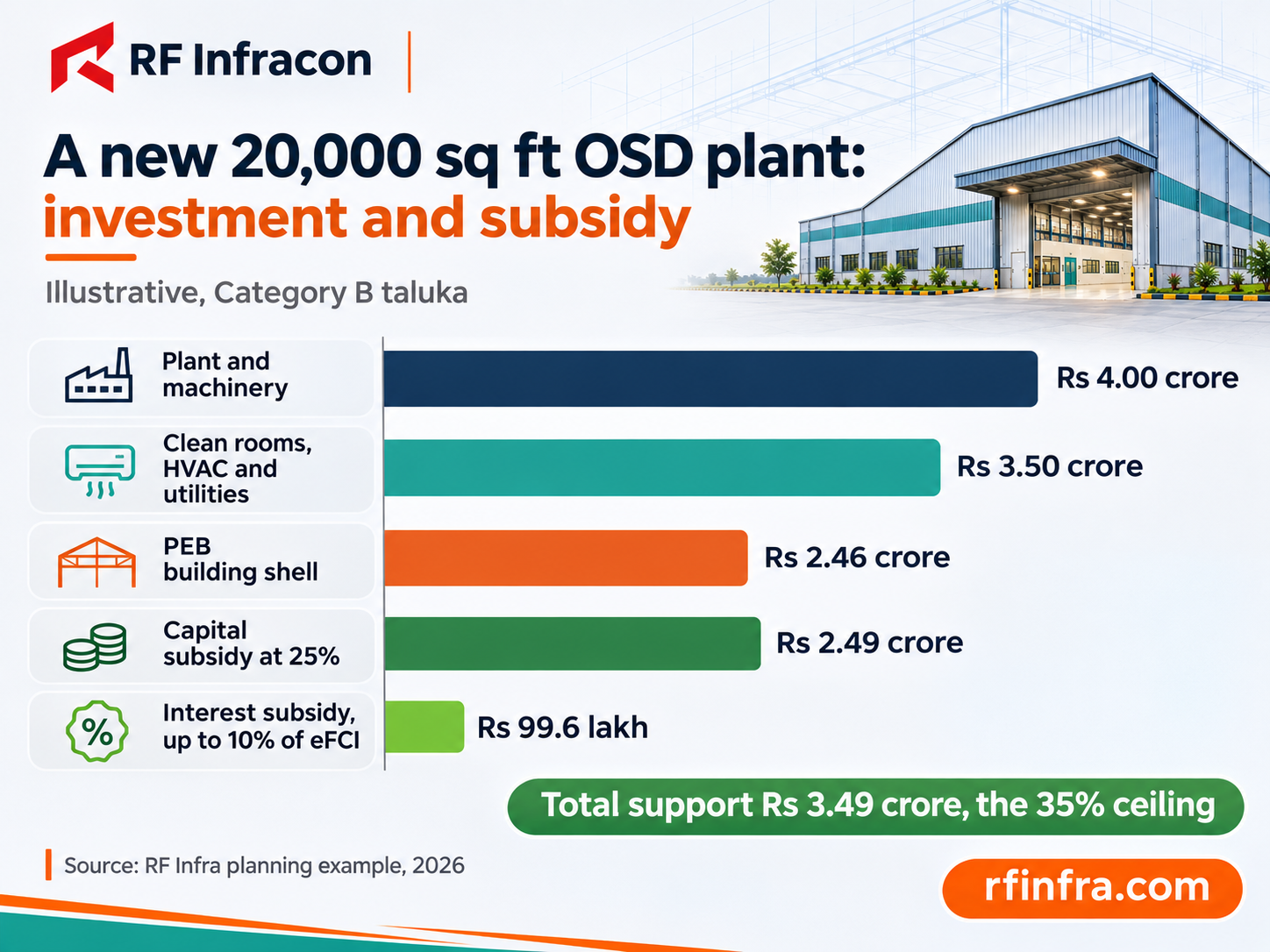
WORKED EXAMPLE: NEW 20,000 SQ FT ORAL SOLID DOSAGE PLANT, SMALL ENTERPRISE, CATEGORY B TALUKA Step 1. Eligible fixed capital investment: PEB building shell at about Rs 1,230 per sq ft = Rs 2.46 crore, clean rooms, HVAC and utilities = Rs 3.50 crore, plant and machinery = Rs 4.00 crore. eFCI = Rs 9.96 crore. Land is kept outside. Step 2. Capital subsidy at 25% = Rs 2.49 crore. Step 3. Interest subsidy at 7% on the term loan, capped at 10% of eFCI = up to Rs 99.6 lakh. Capital plus interest = Rs 3.49 crore, which equals the 35% overall ceiling. Step 4. In a Category A taluka, the same project could reach the 45% ceiling, about Rs 4.48 crore. The building shell alone supports about Rs 61.5 lakh of capital subsidy at 25%, if eligible and properly documented. (Illustrative only. Annual ceilings, payment timing and eligibility come from the GR and the sanctioning authority.) |
For an existing unit upgrading instead, a Rs 80 lakh HVAC and clean room upgrade by a unit with turnover below Rs 50 crore would, at 20%, mean about Rs 16 lakh of RPTUAS reimbursement, within the per unit cap. Our factory setup cost guide for Gujarat covers wider budgets.
Get a line item quotation that separates PEB structure, foundations and civil work, flooring, roofing and insulation, and services.
Keep clean room, HVAC and water system contracts and invoices separate from the building, since they may fall under different schemes.
Pay every bill through bank channels with proper GST invoices in the unit's name.
Keep as built drawings, measurement records and completion documents from each contractor.
Track dates against the scheme's operative period and claim deadlines.
Our guide to PEB quotation inclusions, exclusions and hidden costs helps you get a quotation clear enough for both your CA and your subsidy consultant.
Buying a plot before checking its taluka category and whether the estate allows pharma.
Assuming RPTUAS will pay for a new building shell.
Mixing land development, building and clean room costs in one invoice.
Designing the shed before the GMP layout and HVAC plan are fixed.
Choosing industrial building contractors who cannot give itemised invoices or as built drawings.
Treating the subsidy as guaranteed before sanction.
No. A good pharma plant is designed around the product, the GMP layout and the market. Subsidy reduces the cost, often paid over several years and only after checks. Pick the right site, layout and team first, then shape the paperwork so you can claim what you are entitled to. Anyone promising a fixed subsidy amount before seeing your project is guessing.
As a PEB structure manufacturer in Gujarat and construction company in Gujarat, we build the shell and civil works that pharma plants sit in. We coordinate heights, loads and openings with your GMP, HVAC and clean room teams, and provide line item quotations, GST invoices and as built drawings for your subsidy file. For one point of contact, our turnkey industrial EPC projects cover design, civil and steel, and PEB Plus combines the PEB frame with civil works and service coordination.
See the industries we serve, our PEB steel buildings service, PEB structures in Sanand and our support to set up a factory in Gujarat.
Yes. New MSME pharma plants can use the state scheme under the Viksit Gujarat Industrial Policy 2026, which lists pharmaceuticals as a core thrust sector and offers capital, interest and power support on eligible fixed capital investment. Confirm eligibility with the District Industries Centre or a subsidy consultant.
Policy summaries put capital subsidy at 35 percent of eligible fixed capital investment in Category A talukas and 25 percent in Category B, within overall ceilings of 45 and 35 percent including interest and power support.
Under the state scheme, eligible investment is described as covering building, plant and machinery, utilities, tools and equipment, so the PEB building generally counts if properly documented. Under RPTUAS, civil and building works are not clearly listed as eligible.
RPTUAS is a central scheme that reimburses part of the cost of upgrading existing pharma units to revised Schedule M or WHO-GMP, covering items such as HVAC, water and steam systems, clean rooms, labs and effluent treatment, for units with turnover below Rs 500 crore.
Summaries describe about 20 percent for units with turnover below Rs 50 crore, 15 percent for Rs 50 to 250 crore and 10 percent for Rs 250 to 500 crore, subject to a per unit cap. Check the current guidelines for the exact cap.
Typically building permission, pollution board consent, fire NOC and the drug manufacturing licence from the state drug control authority, along with other registrations for your unit. A regulatory consultant can confirm the exact list.
The PEB shell for a pharma unit costs more than a normal factory shed because of ceiling and AHU loads, insulation and better floors. In our illustrative 20,000 sq ft example it came to about Rs 1,230 per sq ft before clean rooms, HVAC and utilities.
It is being developed at Jambusar in Bharuch district with shared facilities such as effluent treatment and solvent storage. Infrastructure work was still in progress in 2026, so check plot availability and timelines with the park authority.
Planning a new or upgraded pharma plant in Gujarat? Share your plot, products and room layout. Our engineers will send a pharma building plan and a subsidy ready, line item quotation. |
