
Better Factory Solutions
7 October 2026

The MSME factory construction subsidy in Gujarat now runs under the Viksit Gujarat Industrial Policy 2026, operative from 1 June 2026 to 31 May 2031. Policy summaries put capital subsidy at 35 percent of eligible fixed capital investment in Category A talukas and 25 percent in Category B, with interest support of 7 percent for five years. Your factory building counts towards that investment, so its cost and paperwork matter.
Most MSME owners we meet in Gujarat ask two questions in the same breath. How much will the factory shed cost? And how much of it will the government give back? Since mid 2026 the answer to the second one has changed, because Gujarat replaced its earlier incentive schemes with a new industrial policy and a fresh MSME scheme.
This guide explains the MSME factory construction subsidy in Gujarat for 2026 from a builder's point of view: who is eligible, what the headline benefits are, how your PEB building feeds into the subsidy, what a factory shed costs this year, and how to keep construction costs subsidy ready.
A clear note first. We are RF Infra, a PEB and industrial construction company near Ahmedabad, not subsidy consultants. The figures below come from published summaries of the new policy as of October 2026. Always confirm your eligibility, taluka category and claim process with the District Industries Centre or a qualified subsidy consultant before you plan around a number.
Planning a subsidised factory in Gujarat? Send us your plot, layout and machine list. We will send a line item PEB quotation that is easy to use in your project report and subsidy file. |
Gujarat announced the Viksit Gujarat Industrial Policy 2026 in June 2026. It is operative from 1 June 2026 to 31 May 2031, and the detailed MSME scheme followed in late September 2026, according to consultant summaries of the government resolution. Three changes matter most for a factory owner:
A "choose your incentive" model. MSMEs can combine capital subsidy, interest subsidy and power tariff support, within an overall ceiling.
Higher headline support. The overall ceiling is 45 percent of eligible fixed capital investment in Category A talukas and 35 percent in Category B, with higher ceilings for some thrust sectors.
A transition rule. Units already in commercial production before 1 June 2026 generally stay under the earlier 2022 schemes, while new and pre production units can opt for the 2026 scheme within the window allowed.
If your project is at the planning stage now, the 2026 scheme is likely the one that applies to you. That is exactly why the way you plan and document the building matters.
Eligibility depends on the GR, but these are the usual starting points:
Your unit is a micro, small or medium enterprise with Udyam registration.
It is a manufacturing unit (or an eligible service activity under the scheme) located in Gujarat.
It is a new unit, or a project that falls within the scheme's rules for expansion or diversification.
It starts commercial production within the operative period and applies within the time limit.
It meets any sector, location or negative list conditions in the GR.
MSME status itself is based on the central definitions. Since April 2025 the investment limits are up to Rs 2.5 crore for micro, up to Rs 25 crore for small and up to Rs 125 crore for medium enterprises, along with turnover limits.
Enterprise | Investment in plant and machinery | Typical factory size we see |
|---|---|---|
Micro | Up to Rs 2.5 crore | Small shed, often 3,000 to 10,000 sq ft |
Small | Up to Rs 25 crore | Factory shed of 10,000 to 50,000 sq ft |
Medium | Up to Rs 125 crore | Larger plant, often with crane bays |
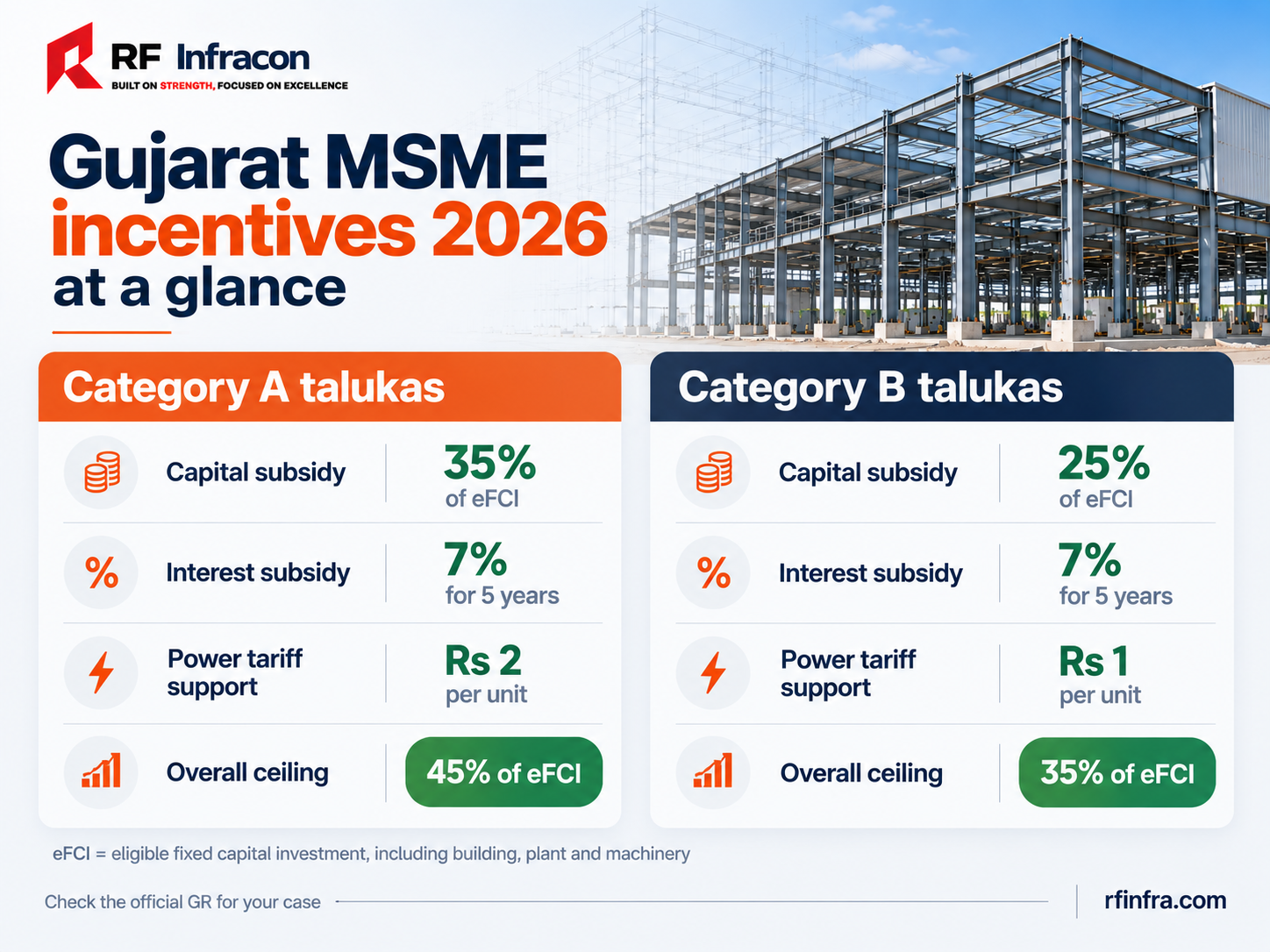
Here is the headline structure as published in several policy summaries. Exact annual ceilings, payment schedules and conditions are in the GR.
Benefit | Category A talukas | Category B talukas |
|---|---|---|
Capital subsidy | 35% of eFCI | 25% of eFCI |
Interest subsidy | 7% for 5 years, up to 10% of eFCI | 7% for 5 years, up to 10% of eFCI |
Power tariff support | Rs 2 per unit for 5 years | Rs 1 per unit for 5 years |
Overall ceiling | 45% of eFCI | 35% of eFCI |
Summaries also mention extra interest support for women, first generation entrepreneurs and startups, higher ceilings for thrust sectors such as toys, footwear, sports goods, robots and drones, plus support like EPF reimbursement, electricity duty exemption and help with quality certification. Capital subsidy for micro units is reported to be paid faster than for small and medium units, which receive it over several years.
Which category is your taluka? That comes from the official list in the policy. Do not assume. Two plots twenty kilometres apart can fall in different categories, which can change your subsidy by lakhs. Our guide to the best GIDC locations for factory setup in Gujarat helps when you are comparing sites.
In most cases, yes. Consultant summaries of the 2026 scheme describe fixed capital investment as covering building, plant and machinery, utilities, tools and equipment. Land is usually treated separately. So the money you spend on your factory shed, foundations and building works generally feeds the eFCI on which capital subsidy and the overall ceiling are calculated.
That has two practical effects. First, a better building is partly paid for by the scheme, so cutting corners on the shed to save a few lakhs makes less sense than it used to. Second, only documented, eligible costs count. A cheap cash deal with no proper invoices may save money on paper and lose it in the subsidy claim.
What exactly is eligible, and how building costs are verified, is set by the GR and checked by the officials. Keep land development, building, utilities and machinery clearly separated in your quotations and invoices so they are easy to classify.
For most MSME factories, a PEB building is the fastest and most cost effective way to build. Typical PEB shed cost ranges from our own cost guides:
Steel structure and roofing only: often around Rs 280 to Rs 450 per sq ft, as covered in our PEB building cost per sq ft guide.
Complete factory shed with foundations, floor, roofing, ventilation and basic services: often around Rs 900 to Rs 2,500 per sq ft depending on specification, as shown in our industrial shed cost calculator guide.
What moves the shed construction cost per square feet most:
Span, eave height and any crane loads.
Foundation depth and soil, plus plinth height.
Floor specification for forklifts and machines.
Roofing, insulation and ventilation choices.
Steel prices at the time of order.
What the quote includes: civil work, services, GST, freight and erection.
Our checklist of hidden costs in PEB factory construction shows what often gets left out of the first number.
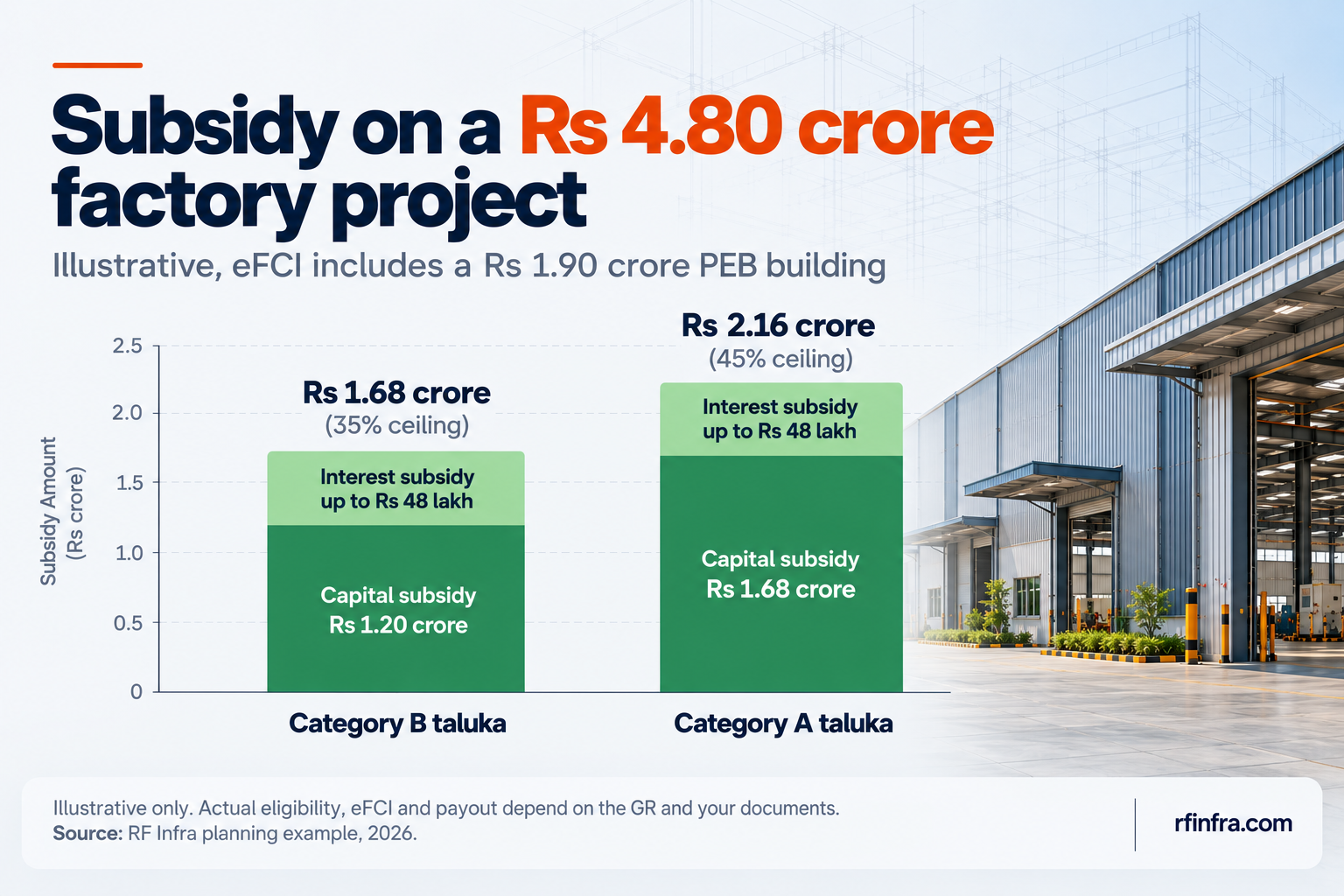
WORKED EXAMPLE: A SMALL MANUFACTURING UNIT WITH A 20,000 SQ FT PEB FACTORY Step 1. Eligible fixed capital investment: PEB building and civil works at about Rs 950 per sq ft = Rs 1.90 crore, plant and machinery = Rs 2.60 crore, utilities = Rs 30 lakh. eFCI = Rs 4.80 crore. Land is kept outside. Step 2. Category B taluka: capital subsidy at 25% = Rs 1.20 crore. Interest subsidy at 7% on the term loan, capped at 10% of eFCI = up to Rs 48 lakh. Together that is Rs 1.68 crore, which equals the 35% overall ceiling, so power support adds nothing more here. Step 3. Category A taluka: capital subsidy at 35% = Rs 1.68 crore, plus interest subsidy up to Rs 48 lakh = Rs 2.16 crore, which equals the 45% ceiling. Step 4. The building alone is Rs 1.90 crore of the eFCI. At 25%, that part supports about Rs 47.5 lakh of capital subsidy in Category B, if the costs are eligible and properly documented. (Illustrative only. Annual ceilings, payment timing and eligibility come from the GR and the sanctioning authority.) |
For the full picture of what a unit costs to set up, see our factory setup cost guide for Gujarat.
Want your building cost laid out for your project report? We prepare line item PEB quotations that separate structure, civil work, roofing and services, so your CA and subsidy consultant can use them directly. |
A subsidy file lives or dies on paperwork. From the building side, plan for:
A detailed quotation and work order that separates PEB structure, foundations and civil work, flooring, roofing, and electrical or other services.
Proper GST invoices for every bill, in the unit's name.
All payments through bank channels, never in cash.
Dates that fall within the scheme's operative period and the rules on when investment can start.
As built drawings, measurement records and completion documents from your contractor.
Any certificates your CA or chartered engineer needs to certify the building investment.
A contractor who cannot give clean, itemised invoices is a risk to your subsidy, however low the rate looks. Our guide to PEB quotation inclusions, exclusions and hidden costs helps you get a quote that is clear enough for both.
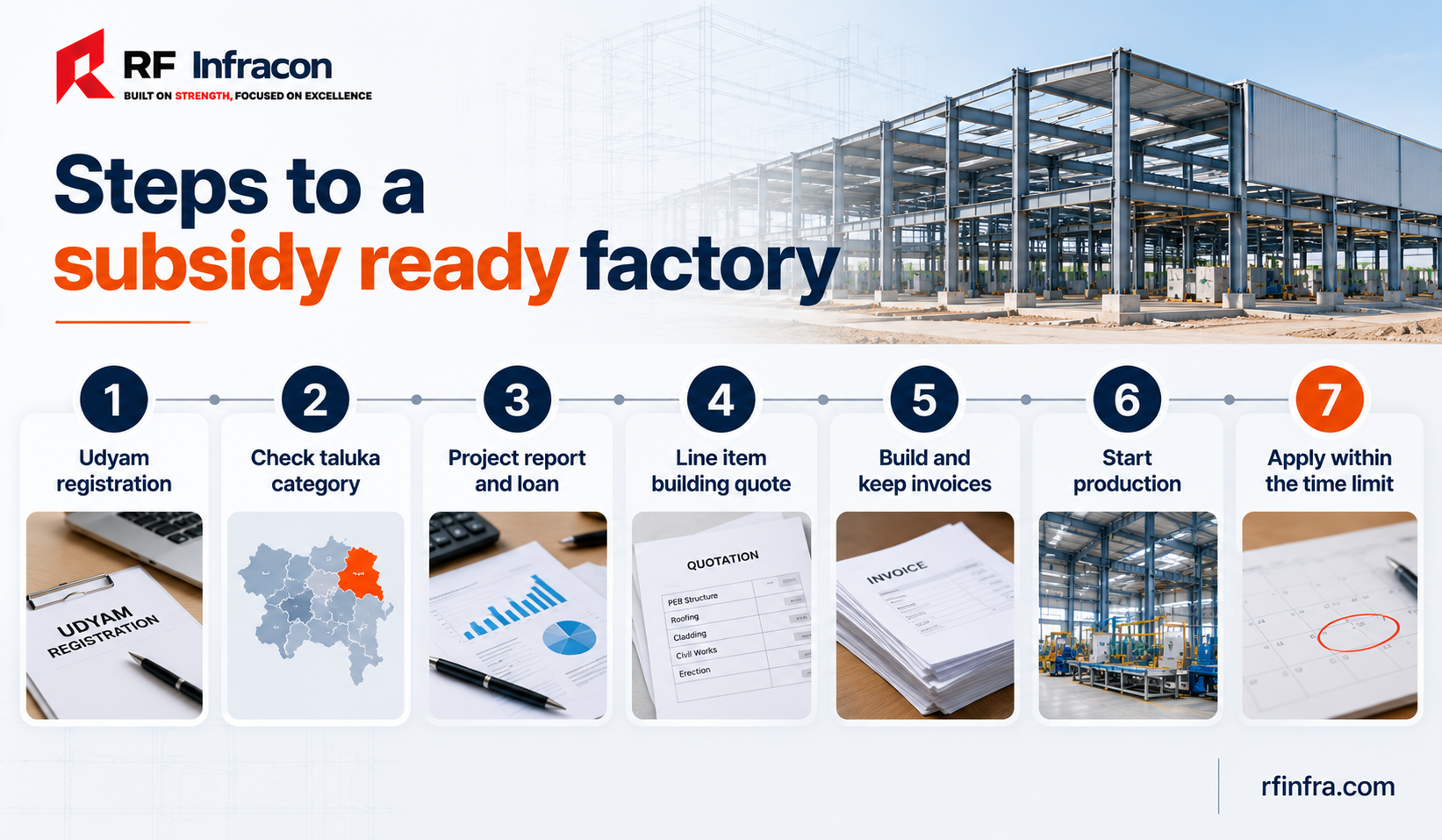
Get Udyam registration and confirm your MSME category.
Check your taluka's category and any sector rules in the official policy.
Prepare a project report with land, building, machinery and utilities clearly split.
Arrange the term loan, since interest subsidy depends on it.
Get a line item building quotation and finalise your factory shed design.
Build, keeping invoices, payments and records in order.
Start commercial production and apply for the incentives within the time limit in the GR.
Our checklist before an industrial construction project covers the building side of these steps in more detail.
Alongside the state scheme, some central schemes can help MSMEs build a factory. PMEGP supports new micro enterprises with a margin money subsidy on smaller projects, and CGTMSE offers credit guarantees that make collateral free loans easier. Rules on combining central and state benefits vary, so check with your bank and consultant before counting on both.
Planning around a subsidy percentage without checking the taluka category.
Assuming land counts towards eligible investment.
Paying the building contractor partly in cash.
Mixing building, machinery and land development in one vague invoice.
Starting production or investment outside the scheme's timelines.
Choosing the cheapest factory shed manufacturer and losing more in rework than the saving.
Honestly, no. The subsidy is a strong support, but it is paid after you invest, often over several years, and only if everything checks out. Choose the location, building and contractor that make sense for your business first. Then use the scheme to reduce the cost.
Also be wary of anyone promising a fixed subsidy amount before seeing your project. Nobody can guarantee approval except the sanctioning authority. Our article on PEB building cost vs long term value explains why the cheapest building is rarely the best investment, subsidy or not.
As a pre engineered buildings manufacturer in Gujarat and construction company in Gujarat, we design, fabricate and build factory sheds and warehouses for MSMEs. For subsidised projects, we provide line item quotations, proper GST invoices, as built drawings and completion documents that your CA and subsidy consultant can work with. If you want one point of contact for design, civil work and steel, our turnkey industrial EPC projects service covers it.
See our PEB steel buildings and industrial shed construction services, or our support to set up a factory in Gujarat.
Yes. Under the Viksit Gujarat Industrial Policy 2026, operative from 1 June 2026 to 31 May 2031, eligible MSMEs can get capital subsidy, interest subsidy and power tariff support on their eligible fixed capital investment, which generally includes the factory building.
Policy summaries put it at 35 percent of eligible fixed capital investment in Category A talukas and 25 percent in Category B, within an overall ceiling of 45 and 35 percent respectively. Exact ceilings and payment schedules are set in the GR.
Generally yes. Summaries of the 2026 scheme describe fixed capital investment as covering building, plant and machinery, utilities, tools and equipment. Only properly documented, eligible costs count, so keep itemised invoices and bank payments.
Land is usually treated separately from building and machinery. Check the GR and confirm with your subsidy consultant before counting any land cost.
Talukas are classified in the official policy list. Check your exact taluka before planning, because the category changes both the capital subsidy rate and the overall ceiling.
Policy summaries describe 7 percent interest subsidy on the term loan for five years, capped at 10 percent of eligible fixed capital investment, with extra support reported for women and first generation entrepreneurs and startups.
A steel structure with roofing often costs around Rs 280 to Rs 450 per sq ft, while a complete factory shed with foundations, floor and services often costs around Rs 900 to Rs 2,500 per sq ft, depending on span, height, loads and specification.
It depends on the GR. Units already in production before 1 June 2026 generally stay under the earlier schemes, while expansion rules under the new scheme should be confirmed with the District Industries Centre or a subsidy consultant.
